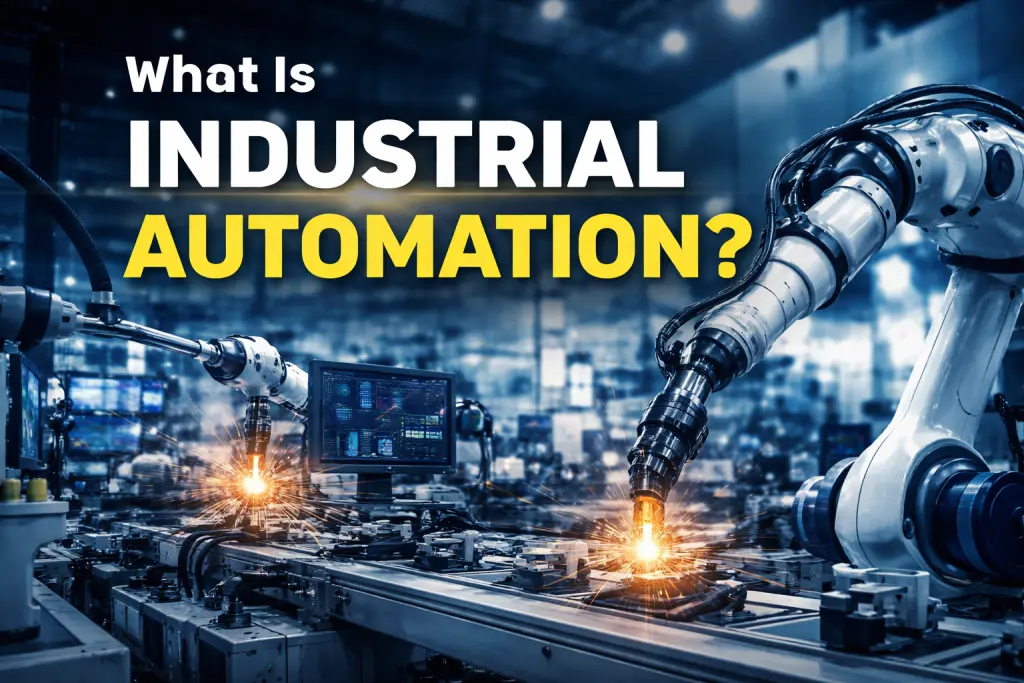
Imagine a factory where machines operate 24/7 with minimal human intervention, producing goods faster, more accurately, and at lower cost. This is not the future — it is already happening. Welcome to the world of industrial automation.
In this guide, you’ll learn what industrial automation is, how it works, its main types, real-world examples, and why it’s transforming industries worldwide.
What Is Industrial Automation?
Industrial automation refers to the use of control systems, machines, and technology to operate industrial processes with minimal human involvement.
These systems use technologies such as:
Computers
Robots
Sensors
Artificial intelligence
The goal is simple:
Increase efficiency, reduce errors, and improve productivity
Why Industrial Automation Matters
Automation is becoming essential for modern industries. Here’s why:
1. Increased Productivity
Machines can work continuously without breaks, significantly increasing production output.
2. Improved Accuracy
Automation reduces human error, ensuring consistent product quality.
3. Lower Costs
Although initial investment can be high, automation reduces long-term labor and operational costs.
4. Enhanced Safety
Dangerous tasks can be handled by machines, reducing workplace accidents.
Types of Industrial Automation
There are several types of automation systems used in industries:
1. Fixed Automation
Designed for mass production
Performs repetitive tasks
High efficiency but low flexibility
Example: Car assembly lines
2. Programmable Automation
Machines can be reprogrammed for different tasks
Suitable for batch production
Example: CNC machines
3. Flexible Automation
Highly adaptable systems
Can switch between tasks quickly
Example: Robotic manufacturing systems
Key Components of Industrial Automation
Automation systems rely on several core components:
Sensors
Collect data from the environment (temperature, pressure, motion)
Controllers
Process information and make decisions (PLCs, computers)
Actuators
Carry out physical actions (motors, valves)
Human-Machine Interface (HMI)
Allows humans to monitor and control systems
Real-World Examples
Industrial automation is used across many sectors:
Automotive manufacturing (robotic assembly lines)
Food production (automated packaging)
Logistics (warehouse automation)
Energy sector (smart grids and monitoring systems)
Advantages of Industrial Automation
Faster production
Consistent quality
Reduced waste
Better resource management
Increased competitiveness
Challenges of Automation
While automation offers many benefits, it also comes with challenges:
High initial investment
Need for skilled workers
System maintenance and upgrades
Potential job displacement concerns
The Future of Industrial Automation
The future of automation is driven by technologies like:
Artificial Intelligence (AI)
Internet of Things (IoT)
Smart factories (Industry 4.0)
These innovations will make systems even smarter, more connected, and more efficient.
Industrial automation is transforming how industries operate. From improving efficiency to enhancing safety, it plays a critical role in modern manufacturing and production systems.
Whether you are a student, entrepreneur, or professional, understanding automation is essential in today’s rapidly evolving industrial landscape.
Final Thoughts
As industries continue to evolve, automation will not replace humans entirely — but it will change how we work. Those who understand and adapt to these technologies will have a significant advantage in the future.
Looking to learn more?
Explore our other guides on manufacturing, business operations, and industrial technology here at Newell Industries.