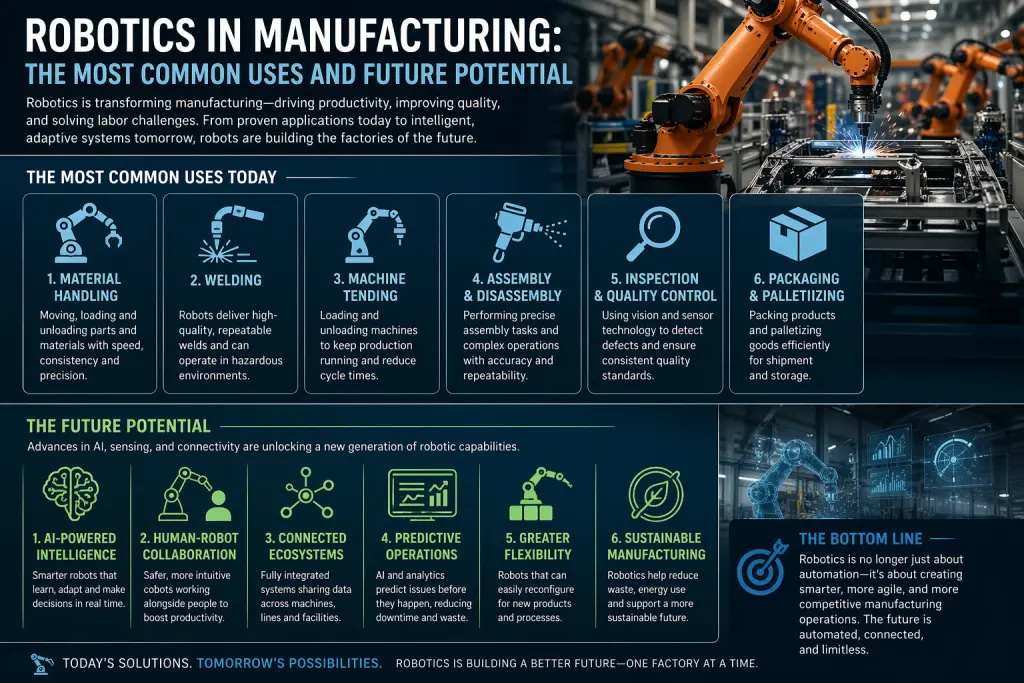
In the realm of manufacturing, robotics plays a pivotal role in transforming the industry landscape. From enhancing production efficiency to revolutionizing precision operations, industrial robots have become indispensable assets for companies seeking automation solutions. This article delves into the diverse applications of robotics in manufacturing, ranging from collaborative robots supporting human workers to 3D printing technology reshaping production processes.
Industrial Robots Enhancing Production Efficiency
One of the primary advantages of industrial robots in manufacturing is their ability to automate repetitive tasks with precision. By handling monotonous and labor-intensive activities, these robots not only accelerate production timelines but also ensure consistent quality outputs. Their integration in assembly lines optimizes productivity and resource utilization, leading to significant cost savings for businesses. Moreover, industrial robots can operate continuously without fatigue, thereby enhancing overall efficiency and output capacity.
Another notable aspect is the adaptability of industrial robots to perform a wide range of functions, including material handling, welding, painting, and packaging. This versatility enables manufacturers to tailor their robotic solutions to meet specific production requirements and scale operations based on demand fluctuations. As technology advances, smart sensors and AI algorithms are being integrated into industrial robots, further enhancing their capabilities and decision-making processes.
Furthermore, the implementation of industrial robots reduces the risk of workplace injuries by undertaking hazardous tasks in high-risk environments. This not only ensures a safer work environment for human employees but also enhances overall operational resilience against unforeseen challenges. With the continued evolution of robotics technology, manufacturing companies are poised to achieve unprecedented levels of efficiency and competitiveness in the global market.
Collaborative Robots (Cobots) Supporting Human Workers
In recent years, collaborative robots, or cobots, have gained prominence for their ability to work alongside human operators harmoniously. These robots are designed to interact with and assist human workers in various tasks, fostering a productive and symbiotic relationship on the factory floor. The collaborative nature of cobots enables them to handle intricate processes that require a human touch, such as delicate assembly or precision quality control.
One of the key benefits of cobots is their user-friendly interface and intuitive programming, allowing quick deployment and seamless integration into existing workflows. Unlike traditional industrial robots that are confined to safety cages, cobots are equipped with advanced sensors and collision detection technology, ensuring a safe working environment for human-robot collaboration. This not only enhances operational flexibility but also empowers employees to focus on complex, value-added activities.
Moreover, the presence of cobots on the production line reduces ergonomic strain on human workers by automating strenuous or ergonomically challenging tasks. By taking over repetitive and physically demanding operations, cobots mitigate the risk of musculoskeletal injuries and enhance employee well-being. As manufacturing industries embrace the era of human-robot collaboration, the integration of cobots is set to redefine traditional production methods and pave the way for more agile and adaptive manufacturing processes.
Robotic Welding Revolutionizing the Industry
In the realm of welding, robotic systems have brought about a revolution in the manufacturing sector by offering unparalleled precision, efficiency, and quality. Automated welding processes carried out by robotic arms ensure consistent weld seam integrity and reduce the likelihood of defects or imperfections. Through advanced programming and real-time monitoring, robotic welding systems optimize welding parameters, resulting in enhanced weld quality and structural integrity.
Robotic welding also offers substantial cost savings for manufacturers by minimizing material wastage and rework, ultimately increasing production throughput and profitability. The seamless integration of welding robots into assembly lines streamlines the manufacturing process, accelerates production cycles, and ensures timely delivery of finished products. Additionally, robotic welding systems can access hard-to-reach or hazardous areas with ease, improving worker safety and operational efficiency.
Furthermore, the adoption of robotic welding technologies opens up opportunities for intricate and complex welding applications, such as welding of dissimilar materials or thin gauge metals. The flexibility and precision of robotic welding arms allow for intricate weld patterns and joint configurations, catering to diverse industrial requirements. With continuous advancements in robotic welding technology, manufacturers can achieve higher levels of precision, repeatability, and weld consistency, setting a new standard for welding excellence in the manufacturing domain.
3D Printing Technology in Manufacturing
3D printing technology has revolutionized the manufacturing industry by offering rapid prototyping, customization, and on-demand production capabilities. Additive manufacturing processes empower companies to create complex geometric designs and functional prototypes with unparalleled speed and efficiency. The ability to produce customized parts on-site reduces lead times and production costs, making 3D printing an attractive solution for small-batch production and product development.
Moreover, the versatility of 3D printing technology allows manufacturers to experiment with diverse materials, including polymers, metals, ceramics, and composites, expanding the scope of application across various industries. The on-demand nature of 3D printing enables agile manufacturing strategies, where products can be tailored to meet specific customer requirements or accommodate design iterations swiftly. This flexibility enhances design freedom and paves the way for innovative product development processes.
Additionally, 3D printing technology promotes sustainable manufacturing practices by minimizing material wastage and energy consumption compared to traditional manufacturing methods. The layer-by-layer additive process generates less scrap material and enables recycling of excess raw materials, contributing to environmental conservation efforts. As 3D printing continues to evolve, its integration into mainstream manufacturing processes is expected to drive efficiencies, creativity, and transformative changes in production workflows.
Robotic Assembly Lines Optimizing Mass Production
Robotic assembly lines have revolutionized mass production by optimizing workflows, reducing errors, and increasing output efficiency in manufacturing facilities. The seamless coordination of robotic arms and intelligent automation systems streamlines the assembly process, ensuring precise component fitting and alignment. By leveraging robotic vision systems and machine learning algorithms, assembly line robots can identify and rectify errors in real time, minimizing production defects and enhancing product quality.
One of the key advantages of robotic assembly lines is their scalability and adaptability to evolving production demands. Manufacturers can easily reconfigure robotic systems to accommodate product variations or changing assembly requirements without significant downtime or retooling costs. This flexibility enables swift response to market trends, customization needs, and supply chain dynamics, enhancing operational agility and competitiveness.
Furthermore, robotic assembly lines excel in high-speed production environments, where efficiency and accuracy are paramount. The consistent performance of robotic systems eliminates variability in assembly processes, ensuring uniform product quality and adherence to stringent manufacturing standards. As companies embrace smart manufacturing practices, robotic assembly lines play a critical role in driving productivity gains, cost efficiencies, and operational excellence across diverse industry sectors.
In conclusion, robotics has emerged as a transformative force in the manufacturing sector, revolutionizing production processes, enhancing efficiency, and unlocking new possibilities for innovation. From industrial robots automating repetitive tasks to collaborative cobots supporting human workers, the integration of robotics technology is reshaping the industry landscape. With advancements in robotic welding, 3D printing, and assembly line optimization, manufacturers are poised to achieve higher levels of productivity, quality, and competitive edge in a rapidly evolving market environment.
What are the main benefits of using industrial robots in manufacturing?
Industrial robots in manufacturing offer advantages such as enhanced production efficiency, cost savings, improved quality control, and increased workplace safety. These robots streamline workflows, minimize errors, and boost overall operational efficiency.
How do collaborative robots contribute to safer manufacturing environments?
Collaborative robots (cobots) work alongside human employees, handling intricate tasks, and automating strenuous operations. By reducing ergonomic strain and mitigating workplace hazards, cobots enhance employee well-being and promote safer manufacturing practices.
What impact does robotic welding have on the manufacturing industry?
Robotic welding revolutionizes the industry by providing precise weld quality, cost savings, and enhanced production throughput. Automated welding processes optimize efficiency, reduce material wastage, and improve worker safety, setting new standards for welding excellence.
How does 3D printing technology revolutionize manufacturing processes?
3D printing technology enables rapid prototyping, customization, and on-demand production capabilities. By offering design flexibility, reduced lead times, and sustainable manufacturing practices, 3D printing fosters innovation and creativity in manufacturing workflows.
What advantages do robotic assembly lines bring to mass production facilities?
Robotic assembly lines optimize workflows, minimize errors, and increase output efficiency in mass production settings. The scalability, adaptability, and precision of robotic systems streamline assembly processes, drive cost efficiencies, and ensure consistent product quality.